← All projects02Real-time2024 – 2025
Passage entre les mondes
Environment film — a botanical world, a portal, a desert
The film opens in a botanical world: ruins overtaken by vegetation, two colossal stone hands holding an energy portal. On the other side, a collapsed city built into the cliffs of a red canyon, where dwellings pile up and cling to one another.
- Context
- HEAJ VFX project. A 2:36 film crossing two worlds linked by a portal held by colossal hands, documented in a 12-page artbook.
- Role
- Concept, moodboards, blocking, modelling, texturing, assembly and lighting in Unity, camera animation, editing, storyboard, artbook.
- Year
- 2024 – 2025
- Team
- Solo
- Tools
- BlenderUnityDaVinci Resolve
Intent
Inspired by Ian McQue's raw aesthetic, the imagination of Castle in the Sky, the atmosphere of Kenshi, Kowloon Walled City and Mad Max. The project was born from an aerial dream — a floating city among flying islands — then sank into a darker reality: the islands collapsed, the verticality remained, turned into a suffocating canyon. The botanical world, where it starts, is the one I prefer: the light, the vegetation, the silence before the crossing.
Process
Step 01
The botanical world
The first world: stone walls under vegetation, warm light through the leaves, then the hands and the portal forming from suspended rocks. It is the part of the film I stand behind most.
Step 02
The artbook, to flip through
Twelve pages telling the project from the initial dream to the canyon: intent, moodboards, blocking, WIP, method, texturing, storyboard, plates. Turn the pages.
Step 03
Modular assets: saving time without losing richness
A few base buildings are modelled and textured, then broken down into simple elements — façades, walls, roofs, pipes, beams, windows. Rearranging them quickly yields new buildings and variants, with consistent materials that reinforce the place's identity. Every reused asset stays light in Unity.
Step 04
Projected texturing, organised in spreadsheets
For such a vast scene, spreadsheets list every asset (buildings, pipes, walkways, rocks) and the texture or projected material attached to it — a method inspired by Ian Hubert. Result: at any moment I know what is textured, what still needs projecting, what needs correcting.
Step 05
On the other side: the desert
The second world: the canyon, the precarious city, the portal turned relic. Harsher, less resolved in my eyes — it closes the film.
Step 06
Final plate — the hand and the portal
The closing plate of the artbook: the colossal hand, its portal, and vegetation reclaiming the place.
Problems met → Solutions
01 · Problems met
Building a whole city alone, within a school project's timeframe.
Solutions
Reusable modular blocks: a limited set of parts generates a wide variety of shapes.
02 · Problems met
Keeping control of texturing across hundreds of assets.
Solutions
Asset ↔ projected texture spreadsheets: clarity, efficiency, consistency.
03 · Problems met
Holding performance in Unity with that much geometry.
Solutions
Reusing light assets fits the real-time engine naturally.
What I keep from it
A production method is worth as much as a beautiful image: it is what lets you finish.
Next project · 03
Éclairage & rendu photoréaliste
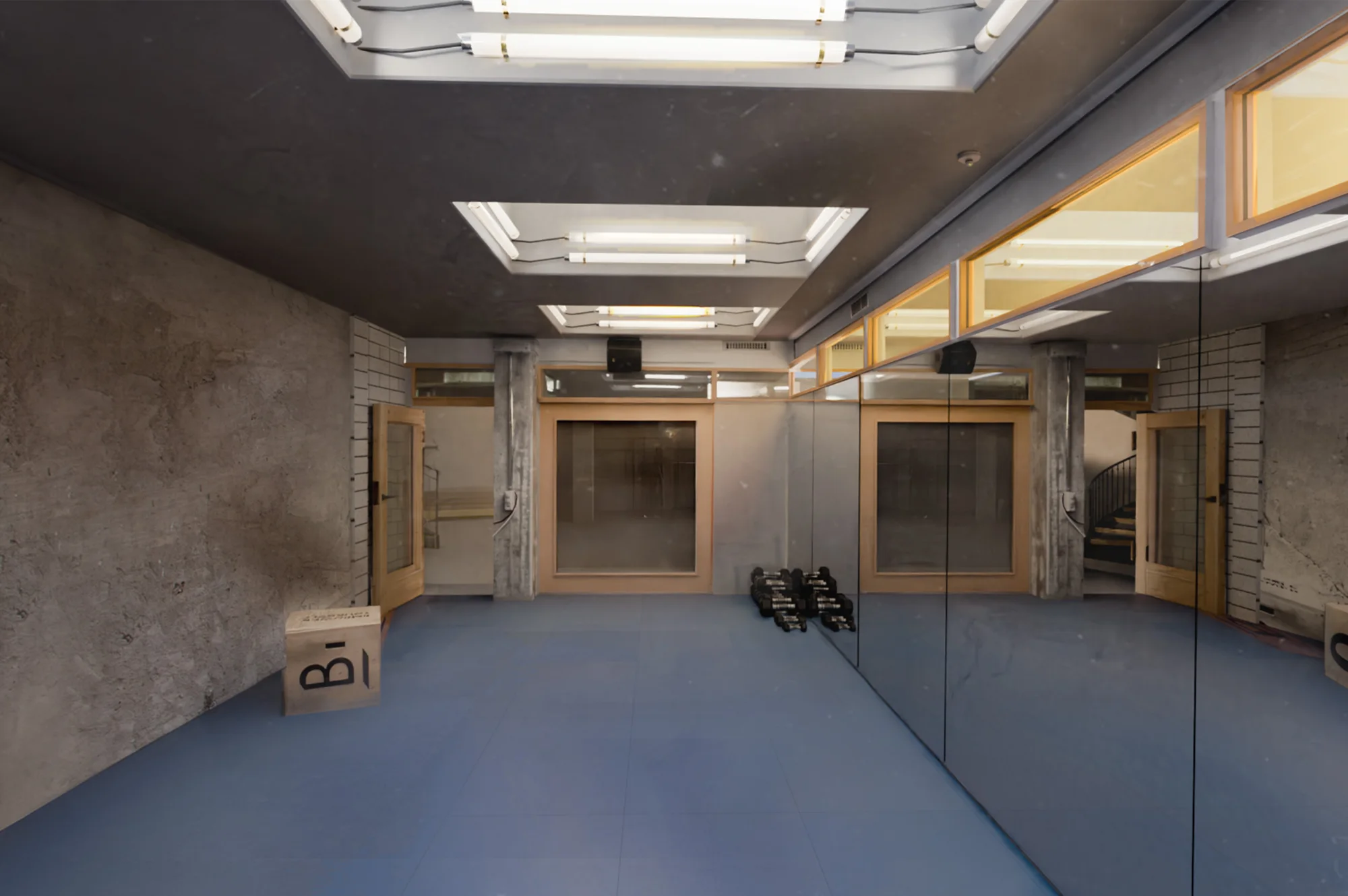
Reproduce a real room until the gap disappears.